


HOME > NEWS > INDUSTRY NEWS > Introduction to Gel Index Tester
2026-08-21
点击量:184
Sample Preparation
Pre-treat the lubricating oil sample to be tested to ensure homogeneity and avoid inaccurate test results caused by uneven samples. Generally, the sample shall be fully stirred or shaken well.
Accurately weigh a certain amount of lubricating oil sample and place it into the sample container of the test instrument. The specific sample mass may vary depending on instrument requirements and test demands, but sufficient sample volume shall be guaranteed to complete the test.
Instrument Settings
Temperature setting: First, preheat the sample at a relatively high temperature (typically 90°C) for a period of time, usually 1.5 hours, to fully mix all components of the sample and reach a stable state. Afterwards, cool the sample at a specified cooling rate (e.g., 1°C/h) in accordance with standard requirements.
Rotor selection and rotational speed setting: Select a suitable rotor according to the viscosity range of the sample and set the corresponding rotational speed. Generally, the test instrument is equipped with rotors of various specifications to adapt to viscosity tests of different samples. For standard SH/T 0732, a measuring rotor and sleeve of specified dimensions are normally adopted, and the viscometer rotational speed is set at 0.3 rpm (revolutions per minute).
Test Procedure
During sample cooling, continuously monitor the viscosity change of the lubricating oil with the viscometer. The viscometer records viscosity data at different temperatures in real time and transmits the data to a computer or the instrument’s built-in data processing system.
As the temperature decreases, certain components in the lubricating oil begin to aggregate and form a gel structure, resulting in a sharp rise in viscosity. Continue monitoring until the viscosity change stabilizes or the test termination condition is met.
Data Processing and Result Analysis
Plot the viscosity-temperature curve based on the viscosity-temperature data recorded during the test. Locate the turning point where viscosity rises sharply on the curve; the temperature corresponding to this point is the gel index temperature.
The gel index is usually a value obtained through specific mathematical calculation or analysis of the viscosity-temperature curve, which is used to quantitatively characterize the gelation tendency of lubricating oil. The specific calculation method may differ for different test instruments and data analysis software, yet it is generally determined based on viscosity variation characteristics and temperature data.
Note: Throughout the test, stable test environment and instrument accuracy shall be ensured, and standard operating procedures shall be strictly followed to guarantee the reliability and repeatability of test results.
The gel index indicates the ability of lubricating oil to maintain stability during storage. A low gel index means the lubricating oil is unlikely to gel during long-term storage and can retain favorable fluidity and performance. In contrast, a high gel index suggests that the lubricating oil tends to form gel structures in storage, which may cause precipitation, stratification and other issues and impair service performance and service life.
For example, for long-term storage, lubricating oil with a low gel index can flow smoothly out of storage containers when required and provide reliable lubrication for equipment.
During equipment operation, lubricating oil is subjected to multiple factors such as temperature, pressure and shear force. Gel index testing helps judge whether the lubricating oil will gel under such complex conditions, so as to ensure continuous and effective lubrication protection for equipment.
For instance, in high-temperature and heavy-duty working environments, lubricating oil with an excessively high gel index may form gels at key positions, weaken lubrication performance and increase risks of equipment wear and failure.
Different types of equipment impose different requirements on lubricating oils. Gel index testing supports the selection of the most suitable lubricating oil for specific equipment. For example, high-precision mechanical equipment requires lubricating oil with a low gel index and high stability to ensure normal operation and precision of the equipment.
For equipment operating in harsh environments, such as mining machinery and marine engines, lubricating oil with an appropriate gel index can improve reliability and durability under severe working conditions.
Knowledge of the gel index of lubricating oil helps users optimize service conditions and extend oil service life. For example, if a certain lubricating oil shows a rapid gel index rise at a specific temperature, gelation risks can be reduced by adjusting equipment operating temperature or adopting cooling measures.
Furthermore, the gel index can be referenced to reasonably determine the oil drain interval and prevent equipment performance degradation caused by premature gelation of lubricating oil.
The primary function of lubricating oil is to reduce friction and wear between equipment components. Gelation of lubricating oil will drastically degrade its lubricating performance and may even lead to lubrication failure. Gel index testing enables timely detection of potential risks of lubricating oil and corresponding measures to avoid lubrication failure.
For critical equipment such as aero-engines and precision machine tools, lubrication failure may trigger severe safety accidents and economic losses, making gel index monitoring of lubricating oil particularly essential.
Lubricating oil with a low gel index can maintain favorable lubrication conditions, reduce wear and corrosion of equipment components, lower equipment failure rates, improve equipment reliability and production efficiency, and cut maintenance costs and downtime.
For industrial production, equipment maintenance and repair usually consume substantial time and capital. Proper lubricating oil selection and gel index monitoring can effectively prevent equipment failures and boost production benefits.
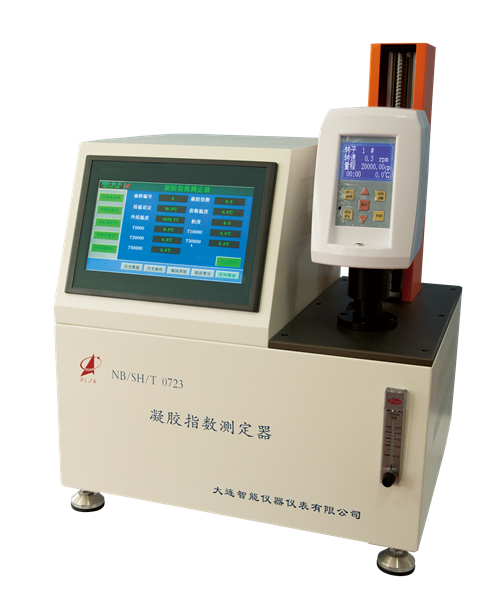
Applicable Standards: NB/SH/T 0732, ASTM D5133
Scope of Application: Measuring viscosity, gel index and gel index temperature of lubricating oils within the temperature range of -5℃ ~ -40℃
Performance Features:
● Adopts advanced imported technology, with combined control of PLC and touch screen to automatically complete testing, calculation and data recording. No on-duty operator is required during the whole test process for high automation.
● Metal bath structure design replaces ethanol coolant, delivering safe and environmentally friendly laboratory operation.
● Uniform cooling rate, high control precision and accurate gel index measurement.
● Supports adjustment of test starting temperature.
● Historical records as well as temperature and gel index variation curves can be reviewed, and test reports can be printed.
● Supports setting of automatic test stop conditions.
● Automatically saves test results and prints test data upon test completion. ● Compatible with LIMS system connection.
Technical Specifications:
Power Supply: AC220V±10%, 50Hz
Temperature Control Range: -50 ~ 80℃
Cooling Rate Control: 1℃/ h
Temperature Control Accuracy: ±0.1℃
Rated Power: 1200W
Overall Dimension: 500×420×700 (mm)